


 () Quote Cart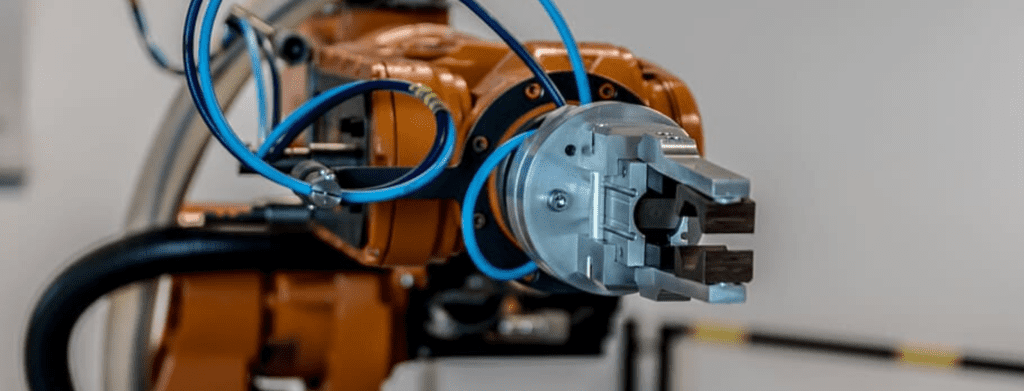
Serving the Factory Automation Sector
The factory automation and industrial control systems market will experience a compound annual growth rate (CAGR) of 9% from 2020–2025, according to Mordor Intelligence.
This increase is the result of automation growth among a variety of industries, necessitated by the use of smarter automated solutions to improve production processes.
Automation industry growth drives the need for adequate cables that can support the unique power and data transfer demands of new and innovative solutions. The design focus of industrial automation cables includes two-way signal communications that facilitate automated equipment control. These signal transmission capabilities make it possible for robotics and other automated equipment to reliably perform a variety of different tasks with precise control.
Industry Challenges
As with any innovation, technological advancements in the factory automation space produce a variety of challenges which require viable solutions. Some of these concerns include:
Maintenance/Reliability
Complexity and sophistication within automated systems produce savings associated with labor, energy, and materials. Proportionate to these advances are those related to quality, accuracy, and precision. More efficient equipment ultimately creates more expensive downtime when it breaks down.
Consequently, power distribution and data cables for production lines, automated machinery, safety systems, and communications require a higher level of reliability and dependability. It is imperative that these components facilitate decreased maintenance frequency and subsequent maintenance downtime. Reliable cable performance ultimately improves uptime, which directly impacts operational efficiency and profitability.
Durability/Flexibility
In a related vein, factories are demanding greater durability and flexibility in their automated components. Cables supplying power and communication to robotic elements undergo extreme levels of mechanical stress during operation because robot technologies require a high frequency of direction changes as they operate.
It is crucial for manufacturers of cables and connectors to meet durability challenges without sacrificing flexibility. Design elements required in automation cables include force compensation, loose braiding, variations in slip planes, and innovative shield concepts to ensure performance after several million cycles.
How Consolidated Electronic Wire & Cable Helps
The modern automated industrial plant requires superior communication and control cables to operate devices and components. At Consolidated Electronic Wire & Cable, we produce solutions that meet and exceed expectations for high performance and reliability.
Meeting Maintenance/Reliability Challenges
To ensure greater operational reliability with lower maintenance frequency, Consolidated provides a range of solutions, including:
- Custom electronic wire and cable
- Data-grade cable
- General line wire and cable
- Multi-conductor cable
- Power cable
Our offerings often exceed customer requirements due to our strict quality assurance testing and inspection practices, executed throughout the production process.
Meeting Durability/Flexibility Challenges
In response to challenges related to durability and flexibility, we have focused our attention on producing custom-designed cables that offer durable performance in normal, flexible, and robotic-flexible applications.
The jacketing material used on custom cables critically affects their flexibility. For demanding applications, we can apply polyurethane jacketing to impart higher strength and greater flexibility than other materials.
Contact Consolidated Electronic Wire & Cable
At Consolidated Electronic Wire & Cable, we meet the essential needs of our clients by serving as a one-stop source for standard and custom electronic wire, cable, power supply cord, molded cable assemblies, and wiring harnesses. We have served virtually every industry and market for wire and cable solutions for over 100 years.
Contact us or request a quote to learn more about the factory automation industry solutions provided by Consolidated Electronic Wire and Cable.
Frequently Asked Questions
— Factory Automation Cables
Have more questions? Our experts are
ready to help you find the right solution.
Standard cables will break rapidly if used in a robotic arm or cable drag chain. Continuous-flex automation cables are engineered with:
- Ultra-fine stranded copper: Utilizing many microscopic strands of copper rather than a few thick strands drastically increases the cable’s flex life.
- Specialized insulation and jacketing: Materials like Polyurethane (PUR) or TPE that glide against each other without generating excessive friction or heat.
- Optimized lay lengths: Internal conductors are twisted at precise angles to absorb mechanical stress during twisting (torsional flex) and bending (rolling flex).
Factory floors are extremely “noisy” environments electrically, due to variable frequency drives (VFDs), large motors, and welding equipment. To protect sensitive data running to PLCs or sensors, we utilize heavily braided tinned copper shields and aluminum foil layers. This provides up to 100% coverage against both low-frequency and high-frequency interference, preventing false signals and machine downtime.
Our automation cables are designed for the reality of the manufacturing floor. They feature rugged jacketing compounds that provide excellent resistance to:
- Industrial lubricants, hydraulic oils, and synthetic cutting fluids.
- Weld spatter and localized high heat.
- Abrasion from dragging across concrete floors or rubbing inside metal cable tracks.
- Match the flex rating to the application: Don’t specify a 10-million cycle torsional flex cable for a stationary sensor; we can help you choose the right cable grade for the specific machine axis.
- Use molded connectors for sensors (M8/M12): Specifying standardized, overmolded M8 or M12 connectors for sensor networks ensures an IP67/IP68 waterproof seal, reducing field failures compared to hand-wired field-attachable connectors.
- Combine power and data: Design a composite cable that houses both power conductors and shielded data pairs under one jacket to reduce routing space and component count.